Why Downhole Tool Failures Are a Design Problem, not a Field Problem
Quick Answer: Most downhole tool failures trace back to the engineering phase - not the drilling crew, not the location, not bad luck. Poor stress analysis, wrong material selection, and designs that were never tested against real wellbore conditions cause the vast majority of costly tool failures. The fix starts at the design table, long before the tool ever goes underground.
A Tool Fails 8,000 Feet Underground. Who Gets the Blame?
Nine times out of ten, the drilling crew does.
The report says something like "unexpected formation pressure" or "harsh wellbore conditions." The tool gets replaced. Drilling resumes. Nobody goes back to ask whether the tool was designed to handle that environment in the first place.
That's a problem - and it's one the oil and gas industry keeps repeating.
Downhole tool failures cost operators billions of dollars every year in non-productive time (NPT), fishing operations, and well damage.¹ But when you actually break down the root causes, the field conditions are rarely the main villain. The design phase is.
What "Downhole" Actually Means (For Anyone Who's New Here)
Think of it like this. You take a tool - could be a drill bit, a shock sub, a mud filter, a connector - and you push it thousands of feet below the earth's surface. Down there, it faces pressure that could crush a car, temperatures that would melt plastic, and vibrations strong enough to crack metal.
That's the downhole environment.
Now here's the part most people overlook: engineers know all of this before the tool goes in. The pressure ranges are predictable. The vibration profiles are measurable. The thermal conditions are calculable. There's no excuse for a tool to reach the field without being designed and validated for exactly those conditions.
When it fails anyway, that's a design gap.
The Three Design Mistakes That Kill Downhole Tools
1. Stress concentrations that nobody modeled
Every time you drill a hole in metal, add a sharp corner, or change the cross-section of a part, you create a stress concentration. Under cyclic loading - which is constant downhole - those spots crack first.
Finite Element Analysis (FEA) exists specifically to find these weak spots before a tool goes into production. A proper FEA simulation maps every area where stress builds up under real operating loads. Without it, you're guessing. And 8,000 feet underground is a terrible place to find out your guess was wrong.
2. Material selection based on cost, not conditions
Some design teams pick materials based on what's cheap or easy to machine. That works fine for plenty of applications. Downhole is not one of them.
High-strength alloys behave differently under high-temperature, high-pressure, and corrosive conditions. A material that looks perfect on a spec sheet can become brittle or lose its fatigue strength once it's cycling through downhole vibration for 72 hours straight. The selection process needs to be tied to the actual load environment - not just tensile strength on paper.
3. Fluid dynamics that were never simulated
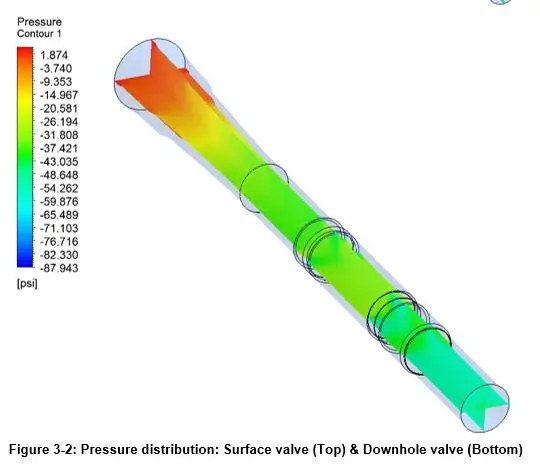
Drilling fluids - also called drilling mud - flow through and around most downhole tools at high velocity. That flow creates erosion, pressure differentials, and thermal stress. Tools that weren't designed with CFD consulting in mind often degrade faster than expected - not because of mechanical overload, but because the fluid dynamics were never factored into the geometry.
CFD simulation shows you exactly where erosion hotspots form, where pressure builds dangerously, and how the fluid interacts with your tool's internal geometry. It's not optional for anything running in a high-flow wellbore.

The Field Crew Isn't the Problem - The Design Brief Was
Here's something that rarely gets said out loud: most drilling crews are following the operating parameters they were given. They're staying within the RPM range, the WOB (weight on bit), the flow rate - all of it.
When a tool fails inside those parameters, that's a design failure by definition.²
The tool was not designed to survive its own operating conditions. That's not a field problem. That's an engineering accountability problem.
Dr. John Mason, a petroleum engineer who has studied NPT causes across offshore wells, noted that a large proportion of downhole failures classified as "operational" were actually attributable to design deficiencies identified only after failure analysis.¹ The field gets the blame because it's easier than rewriting the design brief.
What Good Downhole Tool Design Actually Looks Like
A properly engineered downhole tool goes through several validation steps before it ever sees a wellbore:
Load case mapping - every force the tool will experience, modeled across its full operating range
FEA stress simulation - locating fatigue initiation points and redesigning before manufacture
CFD flow analysis - understanding how drilling fluid moves through and around the tool
Material testing - verifying that selected alloys behave as predicted under downhole-specific conditions
Prototype testing - physical validation against the simulated load cases
This is exactly the kind of product design and development process that separates tools which last from tools that don't.
None of this is exotic. The technology exists. The software exists. The know-how exists. The issue is that some manufacturers skip steps to hit a delivery date or a price point - and operators pay for it later in NPT costs that dwarf what the validation would have cost.³
Stop Blaming the Field. Start Fixing the Design.
Downhole tool failures aren't inevitable. They're predictable - and preventable - when the right engineering process is applied up front.
The industry has the tools to do this right: simulation software, FEA, CFD, advanced materials testing. What's sometimes missing is the discipline to use them on every project, not just the high-budget ones.
If your tools are failing in the field, the answer isn't to brief the crew differently. It's to go back to the engineering phase and find what was missed. That's where the failure started. That's also where it gets fixed.
Frequently Asked Questions
Q: What causes most downhole tool failures?
A: Most failures trace back to design-phase issues - stress concentrations, poor material selection, or flow dynamics that were never modeled. Field conditions get the blame, but they're usually working exactly as predicted. The tool just wasn't designed for them.
Q: Can FEA actually prevent downhole tool failures?
Q: How do wellbore conditions affect tool design?
Q: Is downhole tool failure always the manufacturer's fault?
Q: How long does proper downhole tool validation take?
References
¹ Society of Petroleum Engineers (SPE). Root Cause Analysis of Non-Productive Time in Drilling Operations. SPE International. https://www.spe.org
² American Petroleum Institute (API). API Specification 7-1: Rotary Drill Stem Elements. API Standards. https://www.api.org
³ Cawley, S. & Parker, J. (2021). Downhole Tool Failure Cost Analysis: NPT Trends in Offshore Drilling. Journal of Petroleum Technology. https://www.onepetro.org
Blogs