CFD Simulation Services: How Engineers Solve Problems Before They Get Expensive
Quick Answer: Every engineering team reaches a point where they need more than a good guess—they need proof the design will work. That's where CFD comes in. It shows how air, heat, and fluids will behave before anything is built, helping teams catch problems early, avoid costly changes, and make better decisions with confidence. At Imaginationeering, we use CFD simulation to turn uncertainty into clear, practical answers.
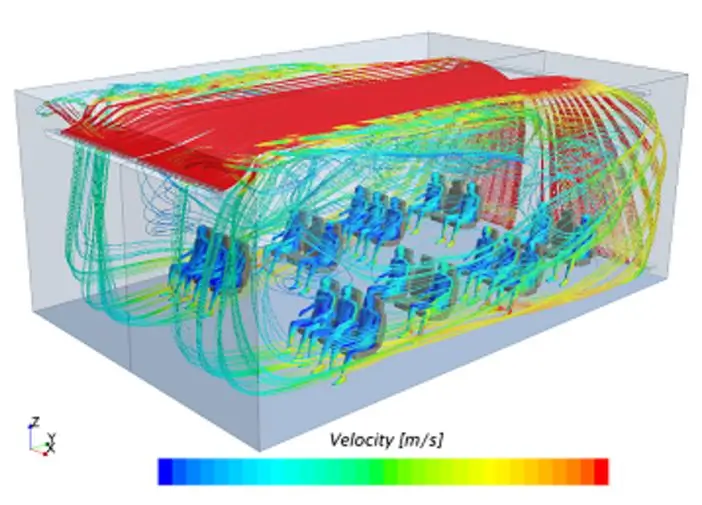
There's a moment in almost every engineering project where someone pauses and asks the question the whole room has been quietly avoiding: "We think this design will work — but how do we actually know?"
That moment is exactly where CFD earns its place.
Computational Fluid Dynamics let's you see how a fluid will behave inside your system before anything gets built. Not a back-of-napkin estimate. Not an assumption based on something similar you ran five years ago. A real simulation of velocity, pressure, temperature, and turbulence in your actual geometry, under your actual operating conditions.
This guide covers how it works, what's genuinely happening behind the results, and why engineering teams that have used it once rarely go back to designing without it.
What CFD Simulation Actually Is
Here's the simplest way to think about it. CFD is a branch of fluid mechanics that solves the governing equations of fluid flow and heat transfer numerically. The computer does math that no human could reasonably do by hand, across millions of points simultaneously, in a fraction of the time physical testing would take.
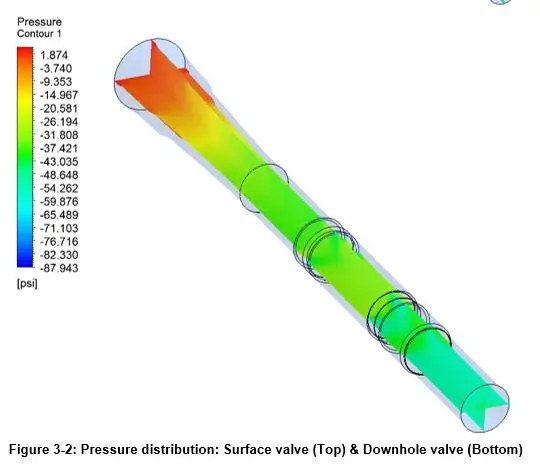
What comes out the other side is a picture of your fluid domain that you simply cannot get any other way: exactly where pressure builds up, where velocity spikes, where heat gets trapped, where flow starts to separate or recirculate. Problems that would be invisible until you were already in the field become obvious on a screen, before a single dollar goes into fabrication.
The honest caveat is that the software doesn't think for itself. Good CFD requires an engineer who understands the physics, builds the mesh correctly, sets realistic boundary conditions, and knows how to look at results critically rather than just accept what the solver spits out. The model is only as good as the judgment behind it.
The Physics Underneath: What the Solver Is Actually Doing
Every CFD simulation, regardless of the software platform, is solving the same core set of equations.
The Navier-Stokes Equations sit at the foundation. They're a set of partial differential equations that describe how momentum moves through a fluid. Add the continuity equation for mass conservation and the energy equation for heat, and you have a complete mathematical picture of how any fluid behaves.
The problem is that these equations have no clean analytical solution for real-world flows. You can't just plug in your geometry and get an answer. So, the solver breaks the fluid domain into thousands or millions of tiny cells, applies the equations to each one, and keeps iterating until the whole solution settles into something stable and physically believable. That process is what people mean when they talk about a simulation of "converging."
Three main approaches handle the math:
Finite Volume Method (FVM) — The standard in industrial CFD. It applies conservation laws directly to each cell, which makes it solid and dependable across complex, irregular geometries.
Finite Element Method (FEM) — More at home in structural analysis but used in some specialized CFD codes. Handles unusual boundary shapes well, though it carries more computational weight for large fluid domains.
Finite Difference Method (FDM) — The oldest of the three. Works best on clean, structured grids. Still shows up in research and niche applications where geometry allows it.
Turbulence: The Thing That Humbles Even Experienced CFD Engineers
If you sit down with a CFD engineer and ask them what keeps simulations honest or dishonest, turbulence modeling is almost always where the conversation goes.
Real fluid flow is messy. At the speeds that matter in most engineering applications, fluids don't glide smoothly from point A to point B. They swirl, tumble, and develop chaotic structures across a huge range of scales all at once. Resolving all that behavior directly would require computational resources so large they're not realistic for most engineering work.
So CFD approximates it with turbulence models. Each one is a different set of trade-offs between accuracy and computational cost:
k-ε (k-epsilon) — The one most industrial CFD runs on. It's reliable, efficient, and well-tested across a wide range of flow conditions. Where it starts to struggle is in situations with strong swirl, significant pressure gradients, or pronounced flow separation.
RANS (Reynolds-Averaged Navier-Stokes) — A broader family of models, including k-ε and k-ω, that averages turbulent fluctuations over time. Fast enough to be practical for complex geometry. The trade-off is that averaging loses some physical nuance.
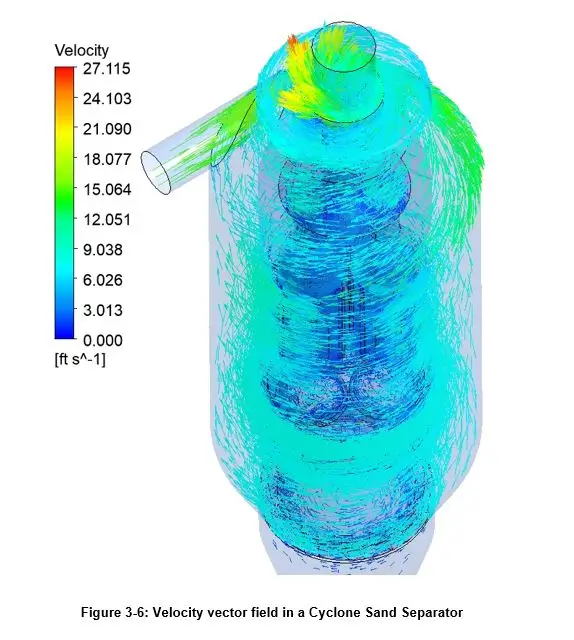
Reynolds Stress Model (RSM) — More sophisticated than k-ε, solving transport equations for each component of the turbulent stress tensor. The right call for anisotropic turbulence, like the swirling flows inside cyclone separators or turbomachinery.
Large Eddy Simulation (LES) — Resolves the large turbulent structures directly and only models the smallest eddies. Noticeably more accurate for complex flows, but it costs significantly more in computing time and resources.
Direct Numerical Simulation (DNS) — Resolves everything, at every scale, with no modeling assumptions at all. As accurate as CFD gets. Also, as expensive as CFD gets, which is why it mostly lives in academic research at low Reynolds numbers.
Choosing the wrong model doesn't just affect your numbers in a minor way. It can produce results that look plausible but lead you in entirely the wrong direction. This is one of those decisions that genuinely matters.
What a CFD Project Actually Looks Like, Step by Step
A lot of people come into their first CFD project without a clear picture of what the process involves. Here's what actually happens:
Step 1: Problem Definition
Everything starts here, and everything depends on getting this right. What do you need to know? Pressure drops across a heat exchanger? Flow separation in a valve? Thermal hot spots in an enclosure? The clearer the question, the better the simulation that answers it.
Step 2: Geometry and Meshing
The fluid domain gets built from your CAD data and is divided into a mesh of cells. This step matters more than most people realize. A poor mesh produces bad results even with a perfect solver. Regions near walls, curved surfaces, and anywhere steep gradients are expected all need finer resolution and careful attention.
Step 3: Boundary Conditions
The simulation needs to know what's happening at every inlet, outlet, and wall: flow rates, pressures, temperatures, rotating surfaces. These aren't just inputs you fill in quickly. Inaccurate boundary conditions produce inaccurate results, full stop, no matter how good everything else is.
Step 4: Solving
The solver works through the equations across every cell, updating variables with each iteration until the residuals, the error between passes, drop to an acceptable level. That's convergence. Looking at results before convergence is a mistake that produces misleading conclusions.
Step 5: Post-Processing and Validation
Results get visualized: pressure contours, velocity vectors, temperature maps, streamlines. Quantitative outputs are extracted. And wherever possible, those results get checked against experimental data or known benchmarks, because a simulation that hasn't been validated is a simulation you can't fully trust yet.

The Financial Case for CFD: Honest and Straightforward
Nobody loves spending money on simulation when there's pressure to move fast. But the math usually works out clearly in CFD's favor.
Physical prototypes are expensive. Testing is expensive. Finding out your design has a pressure drop problem or a thermal issue after fabrication. When the fix means new tooling, rework, or scrapped hardware, is significantly more expensive than either of those. CFD moves problem discovery to the one point in a project when making changes is still cheap.
What that means practically:
Running 20 design variations in simulation costs a fraction of building and testing 3 physical prototypes
Catching a pressure drop problem in the model takes hours to address; catching it post-installation can cost weeks and serious unplanned budget
Heat transfer optimization done virtually carries through to real energy savings over a product's entire operating life
In aerospace, pharmaceuticals, and other regulated industries, simulation data adds meaningful support to physical testing in regulatory submissions
The return on investment varies by project. But for any work where fluid behavior plays a significant role, CFD reliably pays for itself. Usually by a wide margin.
Where CFD Gets Put to Work Across Industries
Aerospace — Wing aerodynamics, engine inlet and exhaust design, thermal management in avionics, rotor performance. At the competitive level, CFD isn't optional here.
Automotive — External aerodynamics, under hood and brake cooling, cabin HVAC, and a fast-growing area: battery thermal management in EVs.
Industrial Equipment — Pumps, compressors, heat exchangers, cyclone separators, mixing vessels, conveying systems. CFD finds performance and efficiency that experience alone tends to be missed.
HVAC and Building Systems — Ventilation effectiveness, thermal comfort, smoke and contaminant dispersion, data center cooling layouts.
Biomedical — Blood flow through stents and heart valves, airflow in respiratory devices, optimization of drug delivery systems.
Energy — Wind turbine aerodynamics, combustion optimization, pipeline flow assurance, heat recovery system design.
Why CFD Is More Accessible Today Than It's Ever Been
A few things have genuinely shifted the landscape in recent years, and they're worth knowing about:
Cloud and High-Performance Computing — Simulations that once required a dedicated hardware cluster, most small teams couldn't justify now run on cloud platforms. Large parametric studies and high-resolution cases are within reach for organizations that previously couldn't touch them.
GPU Acceleration — Graphics cards built for gaming turned out to be remarkably good at accelerating CFD solvers. Jobs that used to take days now finish in hours. That changes what's practical on a project timeline.
Open-Source Solvers — OpenFOAM has matured into a genuine industrial tool. Removing per-seat licensing from the equation changes the economics of CFD in a meaningful way for a lot of teams.
Coupling with FEA — Modern workflows increasingly connect CFD results directly into structural finite element analysis, enabling fluid-structure interaction studies for components that live under both fluid loads and mechanical stress at the same time.
From Simulation to Real Hardware: Where the Value Gets Kept or Lost
CFD tells you what geometry needs to be. Producing that geometry accurately in physical hardware is a manufacturing problem, and it's the step where simulation value either gets realized or quietly disappears.
An impeller with blade angles and leading-edge profiles optimized for peak flow efficiency is only as good as the machining that produces those features. Tolerance stack-up, surface finish on flow-critical surfaces, dimensional accuracy in inlet passages: all of it determines whether the part performs the way the simulation said it would.
Imaginationeering works directly alongside CFD engineering teams that bring well-grounded, accurate simulation results to the table.
Ready to Work with Imaginationeering?
What CFD ultimately gives you confidence before you commit. Confidence that the design performs. That pressure drops stays where it needs to be. That thermal behavior won't become someone else's problem six months after the product ships.
Frequently Asked Questions
How long does a CFD simulation project usually take?
It honestly depends on the complexity of your geometry and what you're trying to learn. A straightforward single-phase flow analysis can wrap up in a few days. More complex cases involving turbulence modeling, thermal coupling, or multiple design iterations typically run two to four weeks. The problem definition phase at the start is what sets the pace for everything else.
How accurate is CFD simulation compared to physical testing?
Do I need to provide CAD files to get started?
What is CFD simulation used for in everyday engineering work?
Blogs