A Quick Guide to Benefits of Cyclone CFD Separators
A practical guide to CFD in cyclone separator design - boost efficiency, cut energy costs, and avoid redesigns with advanced simulation techniques.
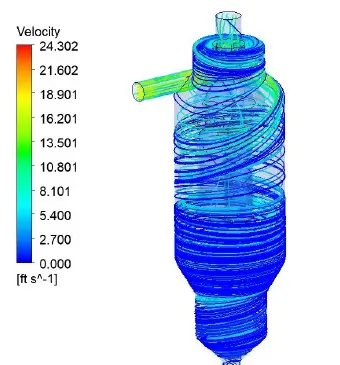
In industries where getting particle separation right actually matters - oil refining, pharma, mining - cyclone separators quietly do a lot of heavy lifting. They're not glamorous. But get the design wrong and you're looking at contaminated products, regulatory headaches, and rework costs that hurt.
What's changed the game over the last decade is how CFD simulation services have made it possible to stop guessing at cyclone performance and start predicting it with real precision. This guide breaks down how that works, and why it matters for engineers who actually have to make these things perform.
What a Cyclone Separator Actually Does
A cyclone separator spins an incoming gas stream to fling particulate matter outward using centrifugal force. The solids hit the wall, spiral down, and exit separately from the cleaned gas. Simple in principle. Tricky in execution, because internal flow behavior - turbulence, secondary vortices, particle bounce-back - is genuinely complex.
For decades, designers worked from empirical rules of thumb: standard geometric ratios, known pressure drop curves, historical data from similar installations. It worked well enough, but "well enough" left a lot of efficiency on the table. You often wouldn't know about a design flaw until you were already running the unit.
CFD changed that.
How CFD Consulting Firms Approach Cyclone Design
CFD consulting firms build computational models that simulate airflow, turbulence, and particle trajectories inside a virtual version of the cyclone - before anything gets fabricated. Engineers can run dozens of geometry variations in the time it used to take to build and test one physical prototype.
The practical upside: you catch problems early. An inlet geometry that creates a reverse-flow zone at the cone tip, or an outlet tube diameter that's too large and lets fine particles escape - these show up in simulation. They don't show up in a surprise drop in separation efficiency after commissioning.
Here's what good CFD work actually delivers for cyclone design:
1. Measurably better separation efficiency
CFD lets engineers optimize the internal geometry - inlet angle, vortex finder length, cone half-angle - against a specific particle size distribution and flow rate. You're not fitting the design to a standard template; you're fitting it to your actual operating conditions. The result is higher cut efficiency, especially for fine particles in the 5–20 micron range that traditional designs struggle with.
2. Lower energy consumption
Pressure drop across a cyclone is directly tied to energy costs. By modeling different inlet velocities and body proportions, engineers can find configurations that hit separation targets while keeping pressure drop as low as possible. Over thousands of operating hours, that difference matters.
3. Avoiding expensive redesigns
Early-stage simulation costs a fraction of what a physical prototype costs. And it costs even less than a retrofit. When a FEA analysis is added alongside the fluid dynamics work, teams can also check structural integrity under operating pressures before the unit ever sees a weld.
4. Cleaner product in regulated industries
In pharmaceutical manufacturing and food processing, particulate contamination isn't just a quality issue - it's a compliance issue. CFD-optimized cyclones can be validated numerically to show that separation efficiency meets the spec before the unit is built. That documentation also has value in regulatory submissions.
5. Faster iteration when requirements change
Process conditions change. Throughput increases, feed material shifts, inlet temperature changes. With a working simulation model, re-optimizing for a new operating point takes hours, not weeks.

Where Cyclone CFD Separators Are Used
The applications are broad, but a few industries use them most intensively:
Oil and gas - Separating gas from entrained solids in pipeline and wellhead applications. Cyclones here operate at high pressures and temperatures, where material selection and flow dynamics both matter enormously.
Mining and minerals - Dust collection in ore processing, where the incoming particle load is high and separator uptime directly affects production rates.
Pharmaceuticals - Spray drying processes produce fine particles that need to be separated from exhaust air without degradation. Tight size distribution control is often a formulation requirement.
Food processing - Flour milling, spray-dried powder production, and grain handling all use cyclones to recover product and keep processing environments clean.
The design priorities differ between these applications - a mining cyclone cares mostly about throughput and robustness, while a pharmaceutical cyclone cares about fine particle recovery and cleanability - but the CFD methodology is the same.
Choosing a CFD Consulting Partner for This Work
Not every CFD firm has real experience with cyclone separator design. It's worth asking specifically about their work in your industry and whether they can show simulation results alongside real-world validation data.
Good firms will also be honest about the limits of simulation. Turbulence modeling in cyclones involves assumptions, and those assumptions affect accuracy - especially near the cone tip where the flow reverses. An experienced team knows where those uncertainties are and accounts for them in how they size up the design margins.
Final Thoughts
Cyclone separators are not a solved problem. They're deceptively simple in concept and genuinely difficult to get right at scale, especially when operating conditions push the limits of standard designs. CFD simulation closes a lot of the gap between what a design is supposed to do and what it actually does once it's running.
If you're designing a new cyclone or trying to understand why an existing one isn't meeting spec, the simulation data will tell you things that experience-based rules of thumb simply can't.
Frequently Asked Questions
Q: How accurate is CFD simulation for cyclone separators?
Modern CFD methods - particularly Reynolds Stress Models (RSM) and Large Eddy Simulation (LES) - produce results that typically agree with physical test data within 5–15% on separation efficiency and pressure drop, depending on the flow regime. The accuracy improves significantly when the model is validated against even a small set of experimental measurements from a similar configuration.
Q: Can CFD be used to retrofit an existing cyclone that's underperforming?
Q: What particle sizes can cyclone separators effectively capture?
Q: Is CFD enough on its own, or do I still need physical testing?

Blogs